| 1. |
How
quickly will my order be done?
|
back
to top |
|
Standard
Service
Your
order is normally sent to you within 2 - 3 weeks of
when your order is confirmed. "Confirmed"
means that your recording had been received and we have
finished any necessary discussion to determine exactly what
work you want done, so work can begin.
Rush Service
Your tablature is sent to you within 1 week of
confirmation of your order - *guaranteed. (*If it takes more
than 1 week, you will only pay regular price.)
|
|
|
| 2. |
How
do I send music to be transcribed? |
back
to top |
|
The
easiest way to send music is as an attachment to an email.
The music should be in MP3, WMA, or other
format.
Here are some helpful notes about this:
A. If your music is already in one of these formats,
simply attach it to your email and send it along with your
order details
.
B. If your
music is in the WAV format:
1. WAV files are most often created when recording
live music or other sound on a computer or digital recorder.
2. Music files in this "wave file" format
(filename extension = .wav), are normally too large to
download in a reasonable amount of time.
3. WAV files should be converted to another format.
(MP3, WMA, or iTunes) Storing
music in one of these formats "compresses" the
file into a package requiring far less memory than
conventional "wave files" and is more easily sent
over the internet net and downloaded.
4.
Inexpensive, or even free software for converting audio file
formats is easily found on the internet.
C. If your
music is on a CD, follow these procedures:
1. Insert an audio CD into the CD drive,
2. Open "Windows Media Player" program.
This music playing program comes with Windows, so it
should be on your computer if you are running a PC
with most any version of Windows.
(I'm sorry, but I am not familiar with the procedure
for Apple computers, but I'm sure it can be done.)
3. Click the "RIP" tab in Windows Media
Player. With ripping, tracks on your audio CDs are copied
onto your computer as files.
4. Within the RIP area, select the appropriate drive
where your CD is located.
5. A list of the
songs on your CD will appear.
6. You can then select the song(s) you want copied
onto your computer.
7. Click "Start Rip" to start ripping.
8. If the ripping begins automatically, clear the
check boxes next to any songs that you don't want to rip.
Or, click Stop Rip, make your selections, and click
"Start Rip" to restart ripping.
(Partially ripped songs are not saved.)
9. Ripped files are automatically added to your
Player library. On your computer, the files are located in
the folder that is specified on the Rip Music tab of the
Options dialog box. You can change the folder at any time.
10. Other options in Windows Media Player
- To select a
different format or bit rate for the files that are created
during ripping, click the arrow below the Rip tab, and then
make your selections from the Format and Bit Rate commands.
- You can also
change the default settings later on the Rip Music tab of
the Options dialog box.
- By default, the
Player begins ripping the CD automatically when you are in
the Rip tab or switch to it after the CD was inserted. You
can also choose to have ripping begin immediately upon
inserting the CD, or you can turn off automatic ripping. For
information about changing these settings, see Change
settings for ripping music.
|
|
|
| 3. |
Will
I be charged for duplicate sections in the music I order? |
back
to top |
|
M
Most
transcribing time is spent listening and deciphering rather than
actual writing out the notes. So by the time it is determine
that a given measure is an exact repeat of a previous one, time
has already been spent. So once a passage is examined, it is
normally written out, unless it is a "significant
section."
A. Significant Sections
NOTE: TMC ="total measure count" (cost is based
on TMC)
It is often not difficult to identify "significantly
large sections" that are very similar to another
section that has already been written out. This refers to a 16
measure section, or some other sizable section of a song that is
easy to separate and listen to. (examples: verse or chorus)
As sections are examined, the
ones that seem similar to one already written can be skipped.
Even though it might not be exact down to the last note, this
can be determined in a relatively short period of time.
No matter how many times a given section repeats, this section
is written out (and charged for) only once. For example, if a
song contained the same 16 M section twice, it would contribute
32 M to the song, but would only contribute 16M to the TMC
("total measure count") that the cost is based on.
In other words, it would take too long to check every measure
and see if there has been another identical measure somewhere
else. But often, quickly listening through an entire section
to compare it to a previous one is easily done to deterrmine
similarity.
B. When comparing sections is not an option
NOTE: TMC ="total measure count" ( cost is based
on TMC)
Most songs are arranged and played in a way that consist
mainly of distinct, standard length sections that are easily
recognized. This makes the TMC relatively easy to obtain by
quickly listening through the song once or twice. And the cost estimate
is based upon this TMC. However, some music is arranged and
played in a less structured way, with sections much less easily
or quickly distinguished. This makes a definitive TMC impossible to obtain
without spending undue amounts of time on the estimate.
Due to this uncertainty of repeating sections in the music, a definitive
TMC is not obtainable until the actual transcribing work is
begun. In such a case, the TMC of the estimate will consist of the
number of measures in the entire recording (or section
requested). The cost estimate is therefore presented as the
entire recording (or section requested) as well. In this
case, along with the estimate, there will be a note to you
explaining this. Of course, repeating sections found during
transcribing will still be written out (and charged for) only once.
|
|
|
| 4. |
What if my order
does not meet the minimum price? |
back
to top |
|
The
minimum charge per order is $50 for all services (except
tabs from the ACT TabList).
If the order that you send does not meet the minimum order
price, here are some options you may consider:
1. simply pay the $50 minimum for this order.
2. expand your order by requesting a larger section
of your song
3. send another song to add to this order.
4. choose one or more "upgrade options" to
add to the order. |
|
|
| 5. |
Which
instruments/playing styles are orders accepted for? |
back
to top |
|
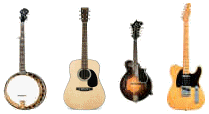
Instrument
Playing style
Music Style
1. 5-string
banjo 3 finger
any
2. Acoustic
guitar FLATpicking
bluegrass & country
3. Mandolin
FLATpicking
bluegrass & country
5. Bass
(upright or electric) ---
bluegrass & country
*NOTE:
If you have a song that you think might not be acceptable as
per above, you are welcome to send it and I will let you know
if I will accept it.
Exceptions can be made at times.
|
|
|
| 6. |
What
does does A.C.T. tab look like? |
back
to top |
|
A.
A.C.T.
Tablature comes in four different formats:
1. TablEdit file (.TEF file format)
- created with TablEdit software
- can be opened in TEFview (free) software to hear and/or print
- can be opened and edited in TablEdit full version
2. Printed or "Engraved" - (PDF file format)
- created with TablEdit software
- three options: tab only, tab & notation, notation only
NOTE:
3. and 4. below apply to A.C.T. TabList only
3. Neat Handwritten - (PDF file format)
- neat, organized, and clearly readable handwritten
- written on professional looking printed tablature paper
(.PDF
file format)
4. Rough Handwritten - (PDF file format)
- readable, but less organized with less detailed notes
- written on handmade tablature paper (.PDF file format)
B.
Here are the formats available for different types of
orders:
1. Transcribed or custom composed tablature formats:
a. TablEdit file
b. Printed or "
Engraved" - (PDF file format)
2. A.C.T. TabList Tablature formats:
1. TablEdit file - used with
tablature created since about 2007
2. Printed or Engraved -
used with tablature created since about 2007
3. Neat Handwritten - used with
tablature created between about 1999 and 2007
4. Rough Handwritten - used
with tablature created between 1994 and 1999
C.
Use the links below to download samples of the four formats.
1. TablEdit file (.tef)
2. Printed or Engraved (.pdf)
3. Neat Handwritten (.pdf)
4. Rough Handwritten (.pdf)
see
"Tablature
Formats" page for more info and options
|
|
|
| 7. |
Why
are all tablature notes written as 1/8 notes? |
back
to top |
|
NOTE:
The following applies unless you request a different
tablature format
A.
In most A.C.T. tablature, all notes are written as 1/8 notes
so that there will always be 8 "stem stubs" at the
bottom of each measure. (There will be more than 8 only when
16th notes are present.) This allows tab readers to visually
see the timing of when to play each note without having to
read standard notation stems for timing of 1/4, 1/2, and whole
notes.
B. For example, if a note
is followed by an empty space above a stem stub, that shows
that that note gets twice as much time because its gets the
time of the single empty space along with its own time.
Followed by two spaces, it will last three times as long. The
main advantage of this is not so much how long the note will
ring, but it will tell you how much time to let go by before
playing the next note.
C. NOTE: If your
order includes standard notation along with tablature, you may
notice some unexpected rests in the notation along with all
the 1/8th notes. A rest indicates silence in between notes.
These rests are shown even though notes may ring longer than
an 1/8 note and there may not be any silence at all between
notes as you play them. These rests may be ignored.
D. Here is why these rests
are shown in the notation:
The rests are only there because the notation is generated
directly from the tablature by the software. Although the
tablature can be manipulated to display all notes as 1/8 notes
and still not display any rests, the standard notation does
not have this flexibility since it is highly standardized
anywhere you see it and it is virtually never changed to suit
the individual music writer's preferences the way tablature
is.
So, for tab or notation, "when" to play each note is
shown, but "how long" they ring is up to you and
your instrument.
see "Tablature
Formats" page for more info and options
|
|
|
| 8. |
Do
you work with clawhammer and similar styles (banjo)? |
back
to top |
|
A.
Not being experienced with
clawhammer (frailing, drop thumb, etc.) style of banjo
playing, I am not confident that I would be able to transcribe
such pieces with accuracy. However, here is what I can
offer:
I would be comfortable writing the melody notes and 5th string
strokes, but the quick strums that occur immediately before
the 5th string strokes would simply be noted in the tablature
as "strums" rather than writing the actual notes.
Usually, the result is a reasonably accurate and playable and
sounds close to the recording.
B. I have done
some frailing/clawhammer for customers under these
circumstances:
1. Customer only wanted a simple facsimile and didn't
care if it was not note-for-note.
2. Customer provided the tuning configuration, or else
they wanted the tab in a standard tuning.
3. Customer only wanted the primary left-hand melody
notes and they would take care of the right hand.
|
|
|
| 9. |
Why
do you charge by the measure instead of by the hour? |
back
to top |
|
Charges
for A. C. T. services are actually based somewhat on time
spent on each order, but not directly. The charge per measure
has been formulated based on an "average" amount of
transcribing time spent per measure of music. The advantage of
charging per measure is that I can give a very close estimate
of the total cost of an order simply by listening quickly
through the music and counting the number of measures.
Customers who are familiar with how music is divided into
measures can also estimate costs for services. (see no.
10 and no. 11 below) |
|
|
| 10. |
How
are measures counted? |
back
to top |
|
A.
Definition of
a Measure
A measure is a relatively small unit of time in which the
smallest repeatable unit of the rhythmic structure of the song
occurs. In other words, a measure is the basic building block
of time throughout a song. The size, or length, of a
measure is defined by how many beats it contains. A given song
will normally be composed of measures all consistently
containing the same number of beats, although small exceptions
do occur.
Therefore, if you know how many beats are in each measure of a
song, you can estimate the number of measures by counting the
beats in the song.
B. Rhythms
Some rhythms sound more complicated than others (for
example, bosa nova compared to bluegrass), but they are all
based on a foundation of simple, primary beats. If you tap
your foot along with a song, you'll usually be tapping along
with these primary beats and this is the simplest way to
identify them. It is the combination of secondary (less
emphasized) beats in between the primary beats that give
different rhythms their unique "flavors."
In a given song in almost any of the common popular styles, a
measure will usually contain 2, 3, or 4 of these primary
beats. These songs are referred to as being in 2/4, 3/4, or
4/4 time, with the top number of each "fraction"
referring to the number of beats per measure. Don't worry
about the bottom number, we're only interested in the top
numbers (2, 3, and 4) for our purposes here.
These three types basically fall into 2 categories:
- those with 3 beats per measure (3/4 time) and
- those with 2 or 4 beats per measure (2/4 time and 4/4
time.)
3/4 Time
Songs in 3/4 time tend to be fairly easy to identify since
this is the common "waltz" rhythm. Also, such a
large majority of rhythms are based on multiples of 2 or 4
beats per measure that songs in 3/4 time really tend to stand
out due to having an odd number of beats per measure,
especially once you get used to identifying them
2/4 And 4/4 Time
The other 95% (guess) of the musical world goes
here - 2/4 and 4/4 time For most of the songs you're likely to
send, your biggest challenge will be deciding whether to call
2 foot taps or 4 foot taps "one measure." Here's
where we're going to take it one step beyond the foot taps.
We're going to single out the one element in most musical
styles that is most capable of telling us how many beats in a
measure - the bass. The bass and drums are responsible more
than any other part of a band for keeping time. Since some
styles don't use drums, we're going to focus in on the bass.
In styles such as traditional country, bluegrass, and folk,
you'll usually hear 2 bass notes per measure. These will
typically alternate back and forth between just two notes as
long as the song remains in the same chord. When the chord
changes, it alternates within a new pair. Often, this one bit
of knowledge is enough to help you get an accurate measure
count by counting pairs of bass notes. If need be, turn the
bass up and the treble down on your music player to hear the
bass instrument better.
C. Cautions
Caution 1! - If you hear the bass begin to suddenly
playing twice as fast, it is now putting 4 notes per measure.
Each measure is still the same length of time as before, it's
just that there are now twice as many bass notes in each
measure. In other words, the bass is playing faster, but the
measures are still going by at the same rate. Sometimes this
is called a "walking bass." Again, the timing
designation for the song is normally based on the parts of the
song with smaller number of bass notes, in this case, 2 bass
notes per measure.
Caution 2! - Normally, you won't hear the bass walk all
the way through the song except for some very old country
recordings or swing music. In this situation, the bass will
often be playing a particular group of 4 notes per measure
(rather than 2) and repeating that same group for each measure
and so on until the chord changes. At other times, the notes
will be in lines going in one direction (up or down in pitch)
and following measures will not repeat these same exact notes.
Other styles may have more complicated rhythms and bass
patterns, but just tap your foot and you'll have a shot at
finding those primary beats. With a little practice you'll be
able to tell if a measure in a song of this type has 2 or 4
beats in the measure.
Caution 3! - Take a deep breath here . . . After
having claimed that most of the styles of music we're likely
to deal with will have 2 primary beats per measure,
accompanied by 2 bass notes, it must be pointed out that this
music will most often be referred to as being in 4/4 time!
This is because the 2 "secondary" beast in between
the 2 primary beats are included in the beat count for each
measure, resulting in a total of 4 beats per measure.
Caution 4! - (Another deep breath) All the above
describes the way country, bluegrass, and folk music is
divided into measure by those who deal with it regularly. This
also applies to many publications that cater to these types of
music. However, in other publications geared to the general
public, you will find many of these same songs written with
twice as much music per measure still noted as 4/4 time. In
this case, only primary beats are counted, so it takes two of
our "country, bluegrass, or folk measures" to make
one of their "general public" measures.
This all shows that determining the timing designation of a
song can depend on how a person interprets the meaning of a
"beat."
D. Note for
Beginners
It's impossible to teach someone who is new at it to
listen to timing this way and expect them to be an expert
overnight. But, as a beginner, if you can just put in some
practice now, you'll soon get a better understanding of how to
apply the above principles for good results. And it is highly
recommend that you find someone with experience to help you
get started.
|
|
|
|
| 11. |
Is
there a quicker way to estimate for myself how many measures
are in my order? |
back
to top |
|
A.
Here is a kind of general way to estimate measure counts for
different types of songs:
(Beware! - songs often
vary in many ways from the "rules" below - use
this info wisely and loosely!
1. A typical vocal song with "normal"
length verse and chorus most commonly have 16 measure verses
and 16 measure choruses. I'm referring to the singing here.
2. Instrumental solos usually are played over either
the verse or the chorus. This means same length, same chords
and same tune as the vocal verse or chorus.
3. Kick-offs (or "intros") are most often
some segment of the verse or chorus, but usually not the whole
thing. Half or quarter of the verse or chorus is common.
4. Same thing applies to endings, although they are
even more likely to be very short.
5. Songs that are completely instrumental sort of
follow the same pattern, except that the instruments take the
place of singers so each instrument will probably play through
the verse and chorus for each solo.
B. Summary
(remember, these are very rough estimates based on common songs -
many variations exist!)
- verse or chorus =
16 measures
- intro or ending
= average of 8 measures
- instrumental
= 32 measures per solo
C. Again - these
are common examples, but many variations exist!
|
|
|
| |
|
|
|
|